Comic-Con 2026: What 130,000 Fans in Costume Taught Me About Brand Equity
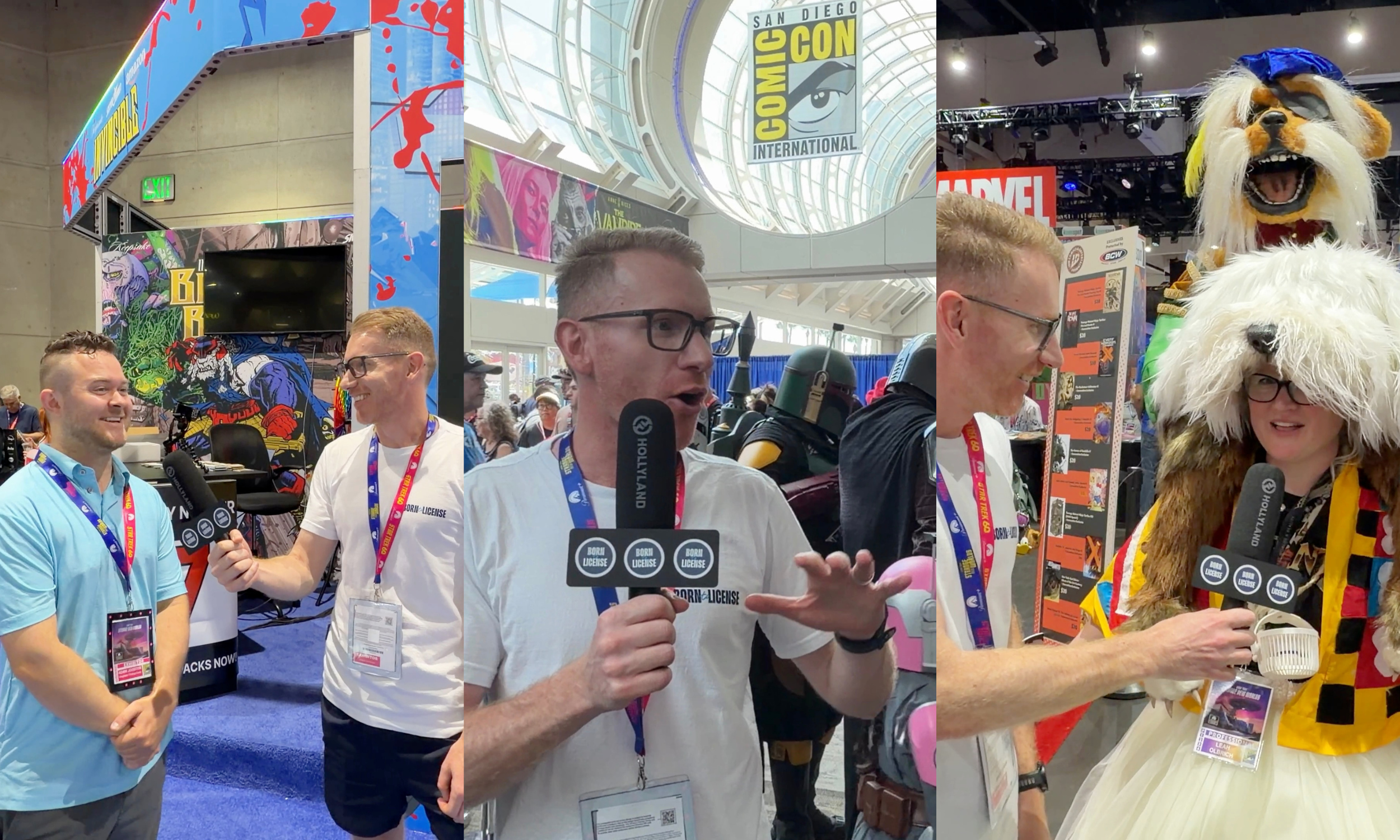
Above: David attended Comic-Con 2026
Twenty years in the licensing industry, and this was the first time I'd ever set foot inside Comic-Con.
Say that out loud and it sounds like an admission. In a way, it is one. I've negotiated licensing deals, structured royalty terms, and helped companies license the world’s best IP for two decades - and I had never stood in the room where the actual product of all that work gets consumed. Not read about in a sell-through report. Not summarized in a quarterly deck. Consumed, in real time, by 130,000 people who paid for a ticket, drove or flew in, and in many cases spent months building a costume for the privilege of standing in a convention center in San Diego.
The floor is where the theory gets tested
Walk into Comic-Con and the abstractions fall away fast. You don't think about "brand equity" as a line item. You watch someone in a hand-built costume - wings that took nine months to construct, working from scratch with no reference kit - explain unprompted why they built it. You watch a line for a signing wrap around a corner twice. You watch someone dressed as Grand Admiral Thrawn, a character from a 1991 novel, explain the character's backstory with more precision than most brand managers can recite their own licensing guidelines.
None of that shows up in a licensing deck.
I spent a chunk of my day at the Keepsake booth, one of our clients at Born to License, watching how they run their Comic-Con presence. Keepsake holds the trading card license for Invincible and Walking Dead, among others, and every single card design - hundreds of them - has to clear Skybound's approval process at concept, reproduction, and final stages before it ever reaches a fan's hands. That's the unglamorous, invisible infrastructure behind the booth. But what Keepsake is actually selling on the floor isn't the card. It's continuity. Adam, who runs their booth presence, told me they see the same faces year after year across San Diego and New York - people they recognize, whose feedback shapes next year's product. That's not a distribution strategy. That's a retention strategy applied to a fandom instead of a customer base, and it's the difference between a licensee who ships product and one who's building a relationship the licensor can't easily replace.
Depth beats breadth, and niche no longer needs permission
Two other things from the floor sharpened the point further.
The first: Pokemon had a big presence on the floor during a year when the brand is celebrating thirty years and has generated over a hundred billion dollars in retail sales - as a single property. It sits in licensing revenue terms alongside portfolio giants like Disney, Warner Bros. Discovery, and Universal, companies with hundreds or thousands of franchises spread across their catalogs. Pokemon does it with one. That's not an accident of nostalgia. It's what happens when a brand owner protects the integrity of a single asset relentlessly for three decades instead of diluting it across extensions that don't fit. Depth, done long enough, outperforms breadth.
The second came from a conversation with David Schnider, a licensing attorney and friend of the podcast, about what's changed on the floor over the past few years: micro-targeting. It used to be that a property needed a tentpole film to justify a licensing program - the theatrical release was the demand-generation engine, and everything downstream depended on it. That's no longer true. Companies are now running production runs for IP that has no film, no mass awareness, and no traditional marketing spend behind it - because social media lets them find the exact audience that property speaks to and sell directly to them. The tentpole used to be a prerequisite. Now it's optional. The audience-finding mechanism has moved from theatrical marketing to a creator with the right following posting the right piece of art.
What this means if you own IP or run a licensing program
Put those three observations together and you get a strategic read that's worth more than any market report: the fans on that floor are proof, not sentiment. If your licensing program can't survive contact with them - if it collapses the moment you take away the marketing budget, the celebrity tie-in, or the theatrical release calendar - it was never built on brand equity in the first place. It was built on borrowed attention.
The brand owners who win long-term are doing what Pokemon did: protecting one asset with obsessive discipline rather than stretching it thin. The licensees who win are doing what Keepsake is doing: treating the booth as a relationship-building exercise, not a point-of-sale terminal. And the newer entrants who are quietly building real programs are the ones who understood before their competitors did that a niche audience, reached directly, is now a viable business model - not a rounding error you tolerate on the way to a bigger deal.
listen to the podcast
The Bottom Line
I've spent twenty years advising people on how to monetize intellectual property, and it took until this year to stand in the room where that IP actually gets loved. That's a gap worth closing earlier than I did. If you run a licensing program, a brand, or a piece of IP you're trying to build leverage around, get out from behind the deck at least once a year and go stand where the fans are. You'll find out in about ten minutes whether what you're building is an asset or a hope.
want to connect?
The Born Perspective is one part of a bigger conversation. If you want more, you can find me on LinkedIn for industry commentary, Instagram for what's happening day to day, and YouTube and the Born to License Podcast for deeper dives into the world of licensing. Pick your platform. I'll be there.
Explore the Born Collective
Everything I build connects back to licensing. Here's where to go depending on what you need: